tmmcore
Transfer-matrix method for multilayer thin-film optics, with exact analytic derivatives.
Takes a stack of layers and returns reflectance, transmittance and absorptance for absorbing and dispersive materials, at any angle of incidence, in s and p polarization. Alongside the spectra it returns the exact thickness Jacobian, the exact thickness Hessian, and the needle-insertion P-function.
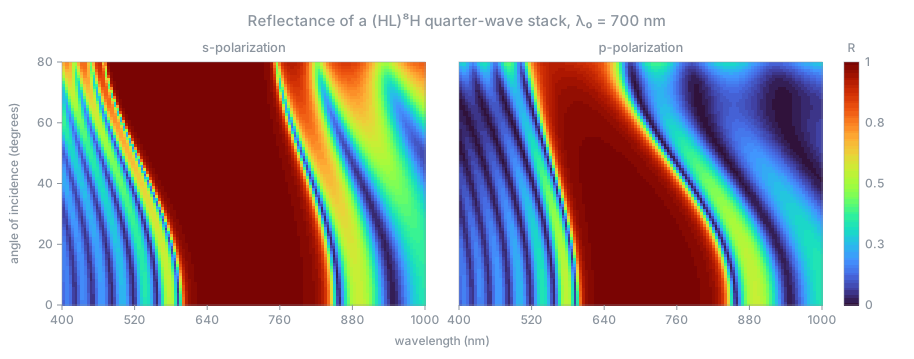
-
Analytic derivatives
The thickness Jacobian, the thickness Hessian and the needle P-function, computed exactly rather than by finite differences.
-
Phase dispersion
Group delay, GDD and TOD as exact frequency derivatives, so they do not depend on the wavelength grid. Their thickness derivatives come from the same call.
-
Node and the browser
JavaScript with no dependencies, and an optional WebAssembly build of the C.
-
Python
The same C kernel as a wheel for your platform, with numpy arrays in and out. See Python.
-
C99
The kernel needs only libm and compiles as one file.
-
Checkable
Four commands, needing only Node, rerun the accuracy checks in Validation.
Install
The WebAssembly binary ships prebuilt, so nothing is compiled at install time. For Python, pip install tmmcore.
A first calculation
import { rta } from 'tmmcore';

// A quarter-wave MgF2 layer on glass, at 550 nm, normal incidence.
const stack = {
    incident: 1.0,                                // ñ = n, or { n, k }
    substrate: 1.52,
    layers: [{ n: 1.38, d: 550 / (4 * 1.38) }],   // quarter wave, thickness in nm
};

const { R, T, A } = rta(stack, 550);

console.log(R);   // 0.012600790214630274
That value has a closed form, \(R = \left(\frac{n_0 n_s - n_1^2}{n_0 n_s + n_1^2}\right)^2\); Validation compares the two.
Implementations
| JavaScript | The reference implementation. No dependencies. |
| C | A line-by-line port of the JavaScript. C99, libm only. |
| WebAssembly | The C, compiled. Opt-in, and over a wavelength grid about an order of magnitude faster than the JavaScript. |
| Python | The C, compiled for your platform and called through ctypes. |
The C matches the JavaScript to float64 round-off, and npm test checks it.
Scope
tmmcore computes coherent stacks. An incoherent substrate, ellipsometric \(\Psi\) and \(\Delta\), and material data are left to the caller; the examples build the first two on its calls. For a full design environment, see TFStudio.
Licence
MIT.